👤 Who This Is For
Working professionals, consultants, and small teams who want to automate repetitive tasks without writing code — and need to decide between the two most popular no-code automation platforms in 2026.
⚡ Bottom Line
Choose Zapier if: you’re new to automation, need the widest app library (8,000+ integrations), and want to be up and running in under an hour without a learning curve.
Choose Make if: you need more powerful multi-branch workflows, want significantly more automation per dollar, or are comfortable investing a few hours to learn a more capable visual builder.
The honest take: Most professionals find that once they’re comfortable with Make, they never look back. But Zapier gets you moving faster — and that matters.
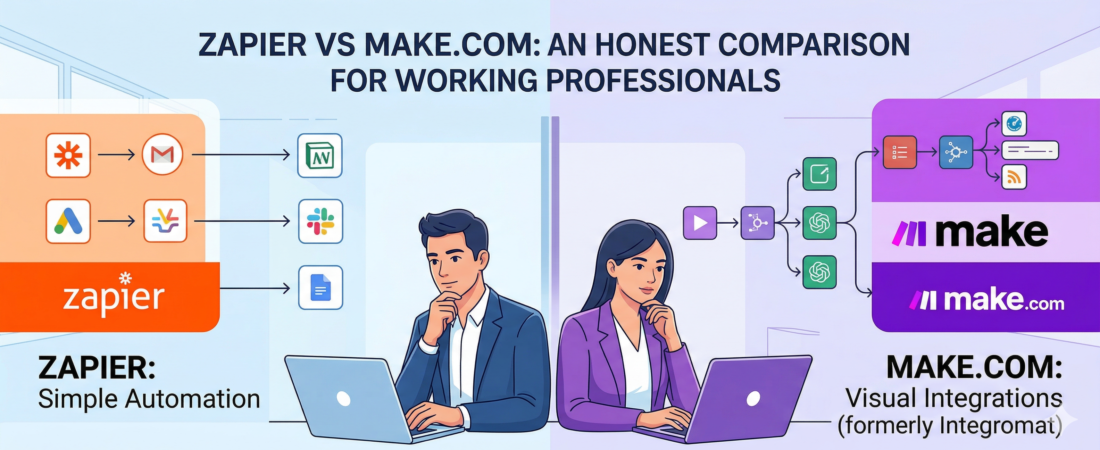
Both Zapier and Make.com connect the apps you use every day and automate the repetitive work that eats into your week. Both are legitimate, widely used, and genuinely useful for working professionals. The question isn’t which one is better in the abstract — it’s which one fits how you work, what you need to automate, and what you’re willing to invest in learning it.
Pricing has changed significantly on both platforms in 2026. Zapier has bundled Tables, Forms, and its new MCP (AI tool connections) into all plans. Make.com switched from an operations-based model to a credit-based system in August 2025. Neither change is cosmetic — both affect how you evaluate cost at scale.
Here is the honest breakdown after using both seriously across real professional workflows.
Quick Comparison: Zapier vs Make.com
| Feature | Zapier | Make.com |
|---|---|---|
| Ease of use | ⭐⭐⭐⭐⭐ Beginner-friendly | ⭐⭐⭐ Moderate learning curve |
| App integrations | 8,000+ | 3,000+ |
| Free tier | 100 tasks/month, 2-step only | 1,000 credits/month, 2 scenarios |
| Entry paid plan | $19.99/mo — 750 tasks (annual) | $9/mo — 10,000 credits (annual) |
| Complex workflows | Limited on lower plans | Strong at all tiers |
| Visual workflow builder | Linear, simple | Advanced canvas, branching |
| AI integration | Zapier MCP + Copilot (all plans) | Native Claude, GPT, Gemini modules |
| Branching / logic | Paths on paid plans | Routers, filters, iterators on all plans |
| Best for | Quick, simple automations | Complex multi-step workflows |
Zapier — The Easiest Way to Start Automating
Zapier is the dominant automation platform for a reason. The interface is clean and guided, templates cover the most common professional use cases out of the box, and the integration library — now at 8,000+ apps — means almost any tool you use has a native connection available. For professionals who need to connect two popular apps and get a workflow running in under an hour, Zapier is the default choice.
In 2026, Zapier significantly expanded its platform. Tables (data storage), Forms (custom input forms), and Zapier MCP (connections to AI tools including Claude and ChatGPT) are now bundled into all plans at no extra cost. Zapier Copilot — an AI assistant that helps you build, troubleshoot, and optimize Zaps — is available on all plans with unlimited messages on paid tiers.
8,000+ Integrations
The largest app library of any automation platform — if your tool exists, it’s probably here
Fastest Setup
Most common workflows — form to CRM, email to task — running in under 15 minutes
Zapier MCP + Copilot
AI assistant builds Zaps for you and connects your workflows to Claude, ChatGPT, and more
Tables + Forms
Data storage and custom form inputs now bundled into all plans at no extra cost
Zapier Pricing — 2026
| Plan | Price (Annual) | Tasks/Month | Best For |
|---|---|---|---|
| Free | $0 | 100 tasks | Testing basic automations only |
| Starter | $19.99/mo | 750 tasks | Freelancers and solo professionals |
| Professional | $49/mo | 2,000 tasks | Growing businesses, complex workflows |
| Team | $69/mo | 2,000 tasks + shared workspace | Teams managing shared workflows |
| Enterprise | Custom | Custom | Large orgs with compliance needs |
What Zapier Does Best
The most common professional use cases — sending Slack notifications when a form is submitted, adding new email subscribers to a CRM, creating tasks from emails, routing leads — are handled in minutes on Zapier. The template library covers these scenarios out of the box, and Zapier Copilot can build them for you in plain English.
Zapier’s 8,000+ integration library is genuinely unmatched. If you use a niche tool — a specialized CRM, a vertical-specific SaaS, a custom database — there’s a meaningful chance it has a native Zapier connection. Make’s 3,000+ library is strong but you’ll hit gaps that Zapier doesn’t have.
Where Zapier Falls Short
Cost scales quickly. The Starter plan’s 750 tasks per month sounds generous until you’re running a dozen active workflows. The Professional plan at $49/month for 2,000 tasks is where most serious Zapier users land — and at that price point, Make delivers dramatically more capability per dollar.
Complex multi-step workflows with branching logic — routing leads differently based on value, processing data through multiple paths, handling errors gracefully — require the Professional plan and still feel constrained compared to what Make handles natively at a lower price.
Make.com — More Power, More Value, More to Learn
Make.com — formerly Integromat — is the most powerful visual automation builder available to non-technical professionals in 2026. Its canvas-based workflow editor shows you exactly how data flows through your automation in real time, which makes complex multi-branch scenarios easier to build, debug, and understand once you get past the initial learning curve.
Make switched from an operations-based to a credit-based pricing model in August 2025. For standard automations, 1 module action = 1 credit — the math is essentially the same as before. The key change is that AI-powered automations now consume credits at a higher rate depending on token usage, which is important to factor in if you plan to build AI-enhanced workflows.
Visual Canvas Builder
See your entire workflow as a map — data flows, branches, and conditions all visible at once
Routers + Branching
Multi-path workflows, conditional logic, error handling — available on all paid plans
3–5x Cheaper
10,000 credits at $9/mo vs Zapier’s 750 tasks at $19.99/mo — dramatically better value at scale
Native AI Modules
Built-in modules for Claude, ChatGPT, and Gemini — add AI to any workflow without code
Make.com Pricing — 2026
| Plan | Price (Annual) | Credits/Month | Best For |
|---|---|---|---|
| Free | $0 | 1,000 credits, 2 active scenarios | Testing and learning the platform |
| Core ⭐ | $9/mo | 10,000 credits, unlimited scenarios | Freelancers, solo professionals — best value |
| Pro | $16/mo | 10,000 credits + priority execution, full logs | Complex workflows, client automations |
| Teams | $29/mo | 10,000 credits + team roles, shared templates | Teams of 3+ managing shared workflows |
| Enterprise | Custom | Custom + SSO, SLA, 24/7 support | Large organizations, compliance requirements |
What Make.com Does Best
Make handles complex multi-step workflows with branching logic, conditional paths, data transformation, and error handling in ways that Zapier’s lower plans simply don’t support. The canvas builder shows you the entire workflow as a visual map — you can see how data moves through every step, which makes debugging significantly easier when something goes wrong.
The value proposition at scale is hard to argue with. The Core plan at $9/month provides 10,000 credits — compared to Zapier’s $19.99/month for 750 tasks. Even accounting for the credit counting difference, Make delivers dramatically more automation per dollar for professionals running multiple active workflows.
Make also has native modules for Claude, ChatGPT, and Gemini built directly into the workflow builder — meaning you can add AI steps to any scenario without needing to configure webhooks or write API calls.
Where Make Falls Short
The learning curve is real. Make’s interface takes longer to get comfortable with than Zapier’s, and concepts like routers, iterators, and aggregators require time investment to understand. Expect 3–5 hours before you’re building complex scenarios confidently. For professionals who need automation running today, that upfront cost matters.
Make’s app library at 3,000+ integrations is strong but significantly smaller than Zapier’s 8,000+. If you use niche or specialist tools, verify they’re available on Make before committing.
Real-World Automation Examples for Professionals
Abstract feature comparisons only go so far. Here’s how each platform handles the automations professionals actually need.
| Automation Task | Zapier | Make.com |
|---|---|---|
| New contact form → add to CRM + send welcome email | ⭐⭐⭐⭐⭐ 10 minutes with template | ⭐⭐⭐⭐ 20–30 minutes, more setup |
| Lead routing — high-value to sales, low-value to nurture | ⭐⭐⭐ Requires Professional plan Paths | ⭐⭐⭐⭐⭐ Routers on all paid plans |
| Weekly report — pull data from 3 sources, format, email | ⭐⭐⭐ Possible but limited | ⭐⭐⭐⭐⭐ Built for this type of task |
| AI-enhanced workflow — summarize email + create task | ⭐⭐⭐⭐ Via Zapier MCP + Copilot | ⭐⭐⭐⭐⭐ Native Claude/GPT modules |
| New hire onboarding — create accounts, send docs, schedule | ⭐⭐⭐⭐ Strong template coverage | ⭐⭐⭐⭐⭐ More flexible multi-branch logic |
| Connecting a niche or specialist app | ⭐⭐⭐⭐⭐ 8,000+ integrations | ⭐⭐⭐ 3,000+ — may need webhook fallback |
The Real Cost Comparison at Scale
The headline numbers — Zapier at $19.99/month vs Make at $9/month — don’t tell the full story. Here’s what professionals actually pay at different usage levels.
Light use
~200 actions/month
Zapier Free: $0 (100 tasks — limited)
Make Free: $0 (1,000 credits — comfortable)
→ Make free tier wins on volume
Solo professional
~1,500 actions/month
Zapier Starter: $19.99/mo (750 tasks — likely insufficient)
Make Core: $9/mo (10,000 credits — comfortable)
→ Make Core wins decisively
Small team
~5,000 actions/month
Zapier Professional: $49/mo (2,000 tasks — need add-ons)
Make Pro: $16/mo (10,000 credits — sufficient)
→ Make Pro wins — 3x cheaper
Pros and Cons
Which One Should You Choose?
Choose Zapier if…
- You’re new to automation and want to start today
- Your key tools aren’t available on Make’s library
- You need simple linear workflows, not branching logic
- Your team is non-technical and needs guided setup
- You run fewer than 500 actions per month
Choose Make.com if…
- You’re willing to invest a few hours to learn the platform
- You need complex multi-branch workflows
- Cost efficiency at scale is a priority
- You want native AI integration in your workflows
- You’re building client automations or managing multiple scenarios
🤖 Automation and AI Agents — What’s the Difference?
Both Zapier and Make are evolving toward AI agent capabilities — not just workflow connectors. Zapier’s MCP integration lets your Zaps communicate with Claude and ChatGPT. Make’s native AI modules let you add AI reasoning steps directly into any scenario.
If you’re new to the concept of AI agents and how they differ from standard automation, our plain-English guide to AI agents explains the distinction and helps you understand when to use a workflow tool versus a true agent.
📋 Key Takeaways
- Zapier is the easiest and fastest way to start automating — 8,000+ integrations, guided setup, and strong template coverage. Best for simple workflows and non-technical teams.
- Make.com is more powerful and significantly cheaper at equivalent usage — 10,000 credits at $9/month vs Zapier’s 750 tasks at $19.99/month.
- Credits vs tasks: Make counts triggers and filters as credits; Zapier does not. A direct numeric comparison overstates Make’s advantage — but the savings are still real and substantial at scale.
- Both platforms now have strong AI integration — Zapier via MCP and Copilot, Make via native Claude, ChatGPT, and Gemini modules.
- For most professionals willing to invest the learning time, Make’s value at scale makes Zapier hard to justify unless you need the wider app library.
📚 Related Articles
- What Are AI Agents? A Plain-English Guide for Professionals
- Best AI Tools for Consultants in 2026: What’s Actually Worth the Money
- Best AI Tools for Marketers in 2026: What’s Actually Moving the Needle
- Claude AI Review 2026: Is Anthropic’s AI the Best Tool for Professionals?
- Best AI Writing Tools for Professionals in 2026: Tested and Ranked
- AI Tools Directory — Browse All Reviews
Ready to start automating your workflow?
Both Zapier and Make offer free tiers — no credit card required. Try the one that fits how you work.